It is the most repeated question in the discipline and the worst answered, usually by people with a commercial interest on one side or the other. So let us separate what the research says from what the videos say.
What actually drives muscle growth
Hypertrophy responds to three things, and none of them mentions the word "dumbbell":
- Mechanical tension. The muscle must produce high force against a resistance.
- Sufficient volume. Effective sets per muscle group per week, repeated over months.
- Progression. The demand has to rise over time.
The body does not care where the resistance comes from. A muscle fibre under high tension close to failure does not know whether that tension came from an Olympic barbell or from your own bodyweight in a one-arm push-up. It responds the same way.
What the research says when comparing the two
The most consistent finding of the last two decades is that when effort and volume are equated, heavy and light loads produce similar hypertrophy. The most cited review on the topic, by Schoenfeld and colleagues, found that sets taken close to failure at around 30% of maximum produced growth comparable to sets at 80%.
The difference shows up in maximal strength, where heavy loads win clearly. If your goal is to lift the heaviest possible weight in a specific movement, the barbell is the better tool. If your goal is for the muscle to grow, both routes work.
The three real reasons you are not growing
1. You are stuck on the same rung
This is reason number one by a distance. Someone does standard push-ups for two years. In month one they were hard; by month twenty-four they do thirty without breathing hard. The stimulus stopped being sufficient around month three.
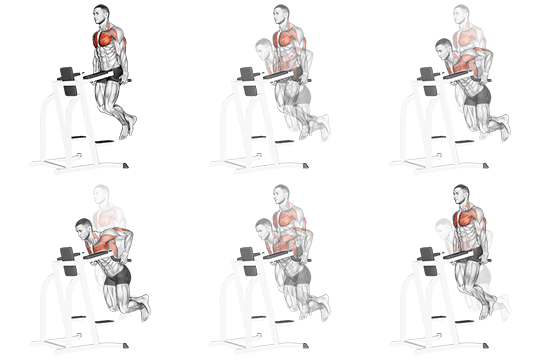
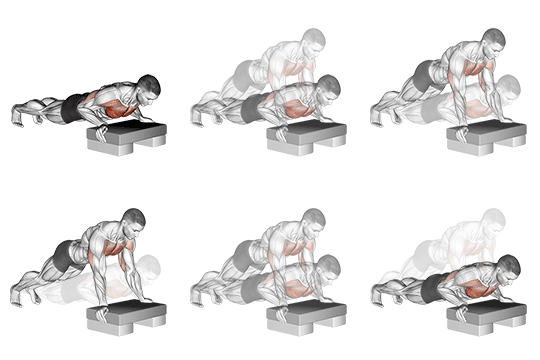
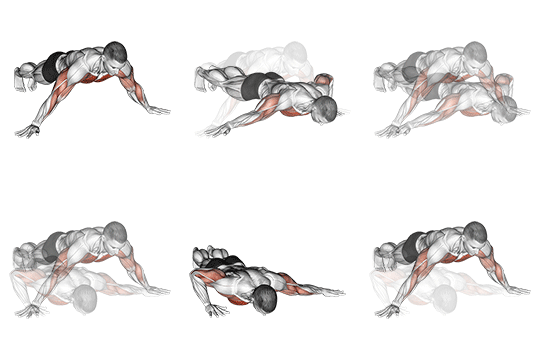
In a gym this does not happen because adding weight is trivial: you add a plate. In calisthenics, progression happens by changing variation, and changing variation requires a deliberate decision that many people never make. The ladder exists: incline → standard → decline → diamond → pseudo-planche → archer → one-arm. Each rung is a real jump in load.
2. You train further from failure than you think
With bodyweight it is easy to misjudge effort, because sets tend to end from boredom or the clock rather than from fatigue. If you finish a set of push-ups and could have done eight more, that set contributed very little.
Rule of thumb: working sets should end one or two reps short of technical failure. If you are not sure whether you are there, you probably are not.
3. You are not eating enough
Muscle is built out of material. Without a modest caloric surplus and adequate protein, perfect training produces very little. This is not specific to calisthenics, but it is where it gets ignored most, because many people arrive from "training at home to get in shape" with weight loss on their mind.
The two numbers that matter: 1.6 to 2.2 grams of protein per kilogram of bodyweight per day, and a modest surplus of 200-300 kcal if the goal is gaining. You cannot gain muscle fast and lose fat fast simultaneously, unless you are a true beginner or returning after a long break.
Where calisthenics genuinely struggles
Being honest here is what makes the rest credible:
| Muscle group | Difficulty | Why |
|---|---|---|
| Chest, shoulders, triceps | Easy | Push-ups and dips cover the entire ladder |
| Back, biceps | Easy, with a bar | Pull-ups and rows; without a bar it gets hard fast |
| Core | Very easy | This is where calisthenics is clearly superior |
| Quads, glutes | Moderate | Requires reaching unilateral work (pistol, Bulgarian) |
| Hamstrings | Hard | Few good options without equipment; the nordic curl is the best |
| Calves | Hard | Single-leg full range is the ceiling without added weight |
Legs are the genuine weak point. Not because they cannot be trained, but because the unilateral ladder is shorter and hits its ceiling sooner. Advanced calisthenics athletes end up needing added weight or plyometrics to keep progressing the lower body.
What a hypertrophy-focused calisthenics routine looks like
- Volume: 10-20 effective sets per muscle group per week. Below 10 progress is slow; above 20 usually produces more fatigue than gain.
- Rep range: 6 to 20. Pick the variation that lands you in that range one or two reps from failure.
- Frequency: each pattern two or three times a week. A 3-day full body routine fits perfectly.
- Tempo: two seconds down, under control. Time under tension is the cheapest way to raise difficulty without changing variation.
- Progression: a numerical exit criterion, not a feeling.
The honest comparison
If your goal is maximum possible muscular development, with no constraints on time, money or access, a well-used gym is the better tool: progression is more granular and the lower body has far more room to run.
If your goal is a strong, muscular physique built at home or in a park, with no membership and no commute, calisthenics gets you there — provided you climb rungs when it is time and eat accordingly. People who "do not grow with calisthenics" have almost always spent months doing the same exercise for the same number of reps.
For the full contrast, see calisthenics vs the gym.
What the app does about this
The problem CalisthenAI solves is precisely the first of the three: knowing when you have outgrown a rung. The strength test places each chain from 0 to 100, the routine uses the variation matching that number, and when the number rises, the variation changes on its own.
The second and third — training close enough to failure, and eating enough — no app can solve for you. Those are yours.