If you train fewer than five days a week, splitting your body into "chest day" and "back day" is a bad idea. With three sessions, a body-part split leaves each muscle trained once every seven days, and once a week is below what it takes to progress well.
The alternative is training the whole body in every session. Each pattern gets worked three times a week in moderate doses instead of once in a huge one. For someone training at home with minimal equipment, this is the structure that returns the most per hour invested.
The five patterns
A full-body session is not "a bit of everything". It is five movement patterns, and every session touches all of them:
| Pattern | What it does | Examples by level |
|---|---|---|
| Vertical push | Shoulders and triceps overhead | Wall push-up → pike push-up → HSPU |
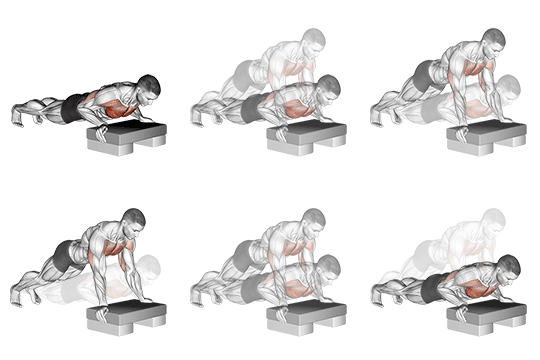
| Horizontal push | Chest and triceps forward | Incline push-up → push-up → one-arm push-up |
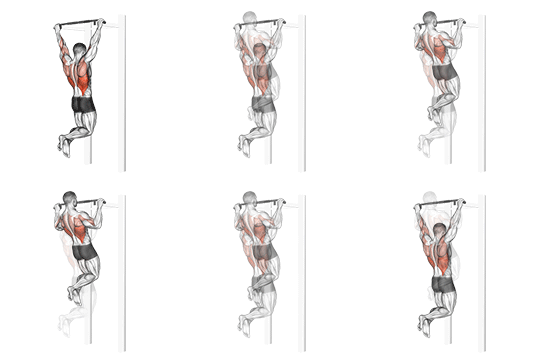
| Vertical pull | Lats and biceps from above | Active hang → negative → pull-up |
| Horizontal pull | Mid back, posture | Australian pull-up → feet-elevated row |
| Legs | Quads, glutes, hamstrings | Chair squat → squat → pistol |
Core gets added at the end. If one of the five is missing from your routine, you have an imbalance waiting to surface — and the one most often missing is pulling, because it needs a bar.
Session structure
- Warm-up, 5-8 min. Shoulder and hip mobility, plus a light set of the first exercise.
- One hard exercise, while fresh. Whatever you are trying to unlock (pull-up, dip, pistol). 4-5 sets, well short of failure.
- Push and pull paired. Two exercises alternated, 3-4 sets each. Alternating saves time without costing quality: while you push, the pulling muscles rest.
- Legs. 3-4 sets.
- Core. 2-3 sets of something anti-extension (plank, hollow body), not a hundred crunches.
Forty-five to sixty minutes. If it takes you ninety, you are resting too long or including exercises that are not earning their place.
The template
Three sessions with at least one rest day between them — Monday, Wednesday, Friday is the classic split and it works. The three sessions are deliberately near-identical: what changes is the emphasis, not the structure.
Session A — push emphasis
- Target exercise: 5 × 3-5 (whatever you are unlocking)
- Push-ups at your current variation: 4 × 6-12
- Australian pull-up or row: 4 × 8-12
- Squat at your variation: 3 × 10-15
- Hollow body hold: 3 × 20-40 s
Session B — pull emphasis
- Pull-up / negative / active hang: 5 × submaximal
- Pike push-up or incline push-up: 4 × 6-12
- Feet-elevated Australian pull-up: 4 × 6-10
- Lunges or Bulgarian split squat: 3 × 8-12 per leg
- Side plank: 3 × 20-30 s per side
Session C — legs and core emphasis
- Single-leg squat at your rung: 4 × 5-8 per leg
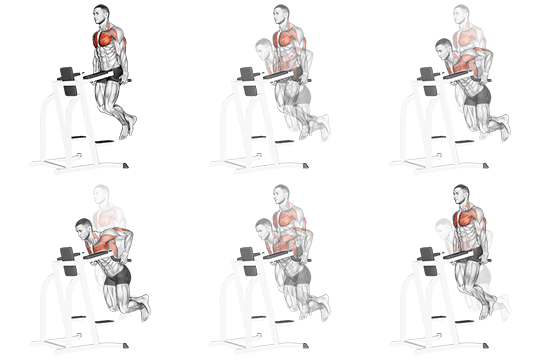
- Bench or parallel bar dip: 4 × 6-10
- Chin-up or Australian pull-up: 4 × 6-10
- Leg raises: 3 × 8-12
- Plank: 3 × 30-45 s
When to move up
The criterion is numerical and not open to interpretation: when you complete every set at the top of the range, with clean form and without reaching failure, the current variation has become too easy.
| Situation | What to do |
|---|---|
| Top of range in every set | Move to the next variation |
| Top of range in the first set only | Stay put another week |
| Same number for three weeks | Check sleep and food before changing anything in training |
| Reps dropping versus last week | Deload week: same training, half the sets |
The mistakes that ruin this routine
- Training to failure on every set. At three times a week, hitting failure on Monday wrecks Wednesday. Leave one or two reps in reserve except on the last set.
- Skipping pulling because you have no bar. The most expensive mistake in home calisthenics. A doorway bar is cheap, and without pulling you are heading straight for a shoulder imbalance.
- Changing routine every two weeks. You do not stall from lack of variety: you stall from never meeting the exit criterion. Variety is the favourite excuse for not measuring.
- Skipping legs. Yes, in calisthenics too.
How long it takes to show
With three well-executed sessions a week, the honest reference is:
- Weeks 1-3: coordination improves and reps climb. Almost all nervous system, not muscle.
- Weeks 4-8: first visible change, mostly shoulders and back.
- Weeks 8-16: concrete milestones unlock — the first pull-up, the first dip.
- Month 4 onward: progress stops being linear and starts depending on how well you manage load.
If someone promises you a transformation in 30 days, they are selling something. What is realistic in 30 days is having the habit established, which matters more in the medium term.
How the app handles it
This template is exactly the structure CalisthenAI generates, with one difference: instead of you picking the variation for each pattern, it is picked from your score on the strength test, which measures each chain separately from 0 to 100.
That matters because almost nobody is equally strong across all five patterns. If you score 70 on pushing and 40 on pulling, the correct routine is not symmetrical — it needs more pulling volume, and following a generic template keeps the imbalance indefinitely.
You can absolutely do this by hand with the table above. The one thing you cannot skip is the exit criterion: if you do not measure, you do not progress. The exercise library has all five ladders ordered by real difficulty.