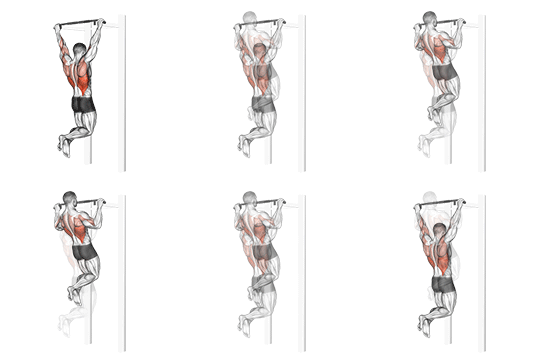
Calisthenics has a quirk the gym does not: every kilo you gain is a kilo you have to move on every rep. That makes body composition a performance variable, not just an aesthetic one. Someone who loses five kilos of fat does more pull-ups without having gained a gram of strength.
That does not mean you need to be extremely lean. It means nutrition decisions have a faster, more visible effect here than in most disciplines.
The only things you need to get right
In order of real impact, highest first:
- Total calories. They decide whether you gain or lose weight. Everything else is fine-tuning.
- Protein. It decides how much of what you gain or lose is muscle.
- Adherence. A mediocre diet you sustain for six months beats a perfect one you drop in three weeks.
- Carb and fat split. Matters for how you feel training, little for composition.
- Timing and supplements. Marginal. Most sports nutrition content is about this, which is what matters least.
Protein: the number that does matter
The best-supported range for people doing resistance training is 1.6 to 2.2 grams per kilogram of bodyweight per day. Above 2.2 there is no consistently demonstrated additional benefit; below 1.6 you leave performance and lean mass on the table, especially in a deficit.
| Bodyweight | Daily protein (range) | In practice |
|---|---|---|
| 60 kg | 96 - 132 g | 3-4 protein servings a day |
| 70 kg | 112 - 154 g | 4 servings |
| 80 kg | 128 - 176 g | 4-5 servings |
| 90 kg | 144 - 198 g | 5 servings |
The protein calculator runs this against your weight and goal, and the calorie one estimates your starting point. Neither needs an account.
A "serving" is roughly 30-35 g of protein: 150 g of chicken or fish, 200 g of Greek yoghurt plus a handful of nuts, five eggs, 200 g of cooked legumes plus a grain, or a shake.
Gaining or losing? Pick one
The classic mistake is trying to do both indefinitely. Outside of three specific situations, it does not work.
Body recomposition — gaining muscle and losing fat at once — does reliably happen in: absolute beginners, people returning after a long break, and people with a high body fat percentage. If you have trained consistently for over a year and are at a reasonable body fat level, you will have to choose.
| Goal | Calorie adjustment | Reasonable rate |
|---|---|---|
| Gain muscle | +200 to +300 kcal/day | 0.25-0.5% of bodyweight per week |
| Lose fat | -300 to -500 kcal/day | 0.5-1% of bodyweight per week |
| Maintain and refine technique | Maintenance | Weight stable ±1 kg |
More aggressive rates mean a larger share of the change is the tissue you did not want to change: muscle when losing, fat when gaining.
The calisthenics-specific issue: strength-to-weight
In movements where you move your whole body against gravity — pull-ups, muscle ups, front lever, planche — what governs performance is not absolute strength but strength divided by bodyweight.
This has an awkward practical consequence: a gaining phase, even a well-run one, temporarily worsens your numbers in those movements. You have not lost strength; you have added load. Worth knowing in advance so you do not read it as a plateau and abandon the phase halfway.
This is why many advanced practitioners alternate: gaining phases focused on raw strength and volume, and maintenance or slight-deficit phases focused on skills. Trying to progress your front lever while gaining five kilos is rowing against yourself.
Before and after training
The area with the most noise and the least importance:
- Before: train however you feel comfortable. If you train fasted and perform well, there is no problem. If you feel lightheaded, eat something light with carbohydrate an hour before.
- After: the famous thirty-minute "anabolic window" does not hold up under current evidence. What matters is the daily protein total, not the stopwatch. Eating within the following hours is enough.
- Hydration: dehydration of 2% of bodyweight already impairs strength performance. That is more relevant than any supplement.
Supplements: the three with evidence
| Supplement | What it does | Worth it? |
|---|---|---|
| Creatine monohydrate | Performance in short, intense efforts | Yes. 3-5 g/day. The best-supported there is |
| Protein powder | Hitting your daily total conveniently | It is food, not magic. Useful if you struggle to hit it |
| Vitamin D | Only if you are deficient | Blood test first; common in winter |
| BCAAs, fat burners, pre-workouts | — | No, if you already eat enough protein |
Creatine works the same in calisthenics as in any strength discipline. The only nuance is some intramuscular water retention, which adds a little weight — irrelevant for most people, worth noting if strength-to-weight is critical for you.
What you can ignore
- Eating every three hours to "speed up metabolism". It does not work that way.
- Avoiding carbohydrates at night. There is no mechanism supporting it.
- "Fat-burning" foods. They do not exist.
- Detoxes. Your liver and kidneys already do that job.
The one-line summary
Get calories right for your goal, eat 1.6-2.2 g of protein per kilo, drink water, and sustain it for months. That is 90% of the outcome. The remaining 10% is where almost all internet nutrition content lives.
If you are just starting and still unsure what to train, calisthenics for beginners is where to go next. And if the question is whether this will actually build muscle, that is answered in can you build muscle with calisthenics?.