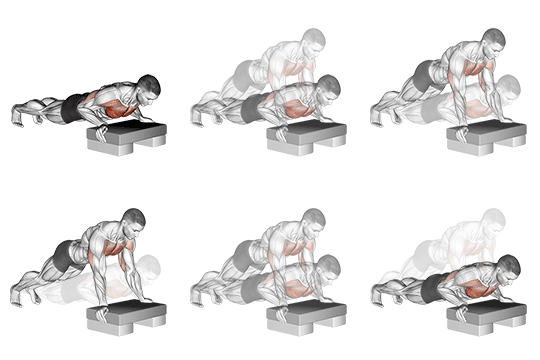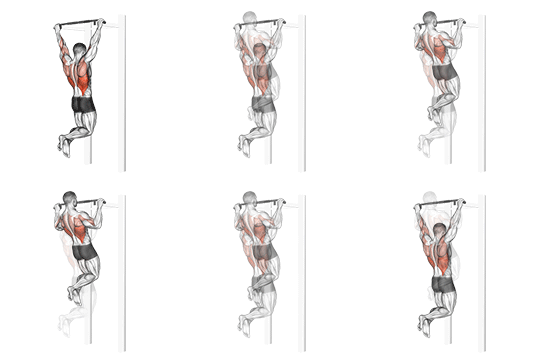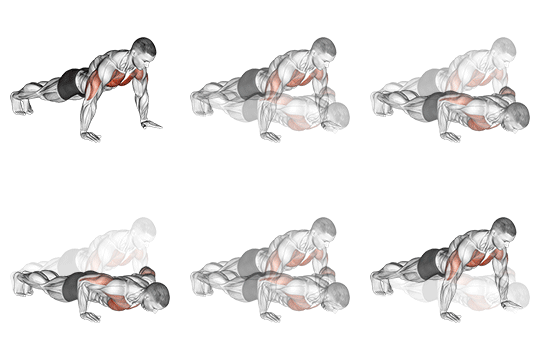
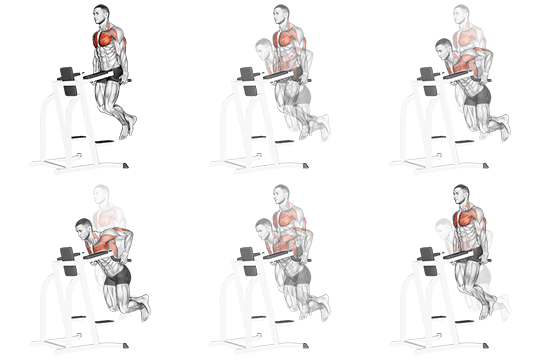
The dip does for pushing what the pull-up does for pulling: it loads the full pattern with your entire bodyweight and does not allow shortcuts. The average adult starting out cannot do a single one, exactly as they cannot do a pull-up.
The difference is that when you cannot do a pull-up, nothing happens — you just hang there. A dip you can do badly, and it is that bad version that causes the injuries. Nearly all of it comes down to one thing: descending further than your shoulder currently tolerates.
What a dip actually trains
It depends on torso angle, and this is the part almost nobody adjusts deliberately:
| Torso position | Primary work | When to use it |
|---|---|---|
| Vertical, elbows tucked | Triceps | If you want lockout strength and pressing power |
| Leaning forward 20-30° | Lower chest | If you want chest mass |
| Leaning with elbows flared | Chest, with far more shoulder stress | Almost never — the worst risk/reward on the list |
The vertical version is the safest and the one to learn first. Forward lean gets added once you own the movement, not on day one.
The depth rule that prevents the injury
The shoulder tolerates the combination of high load and end-range internal rotation poorly. That is precisely what happens in a deep dip when the shoulders roll forward at the bottom.
Going below 90° is not inherently dangerous — gymnasts do it daily. It is dangerous without the scapular control that supports it, and the gap between those two states is practice time in the range you already own.
The ladder, from zero to full dip
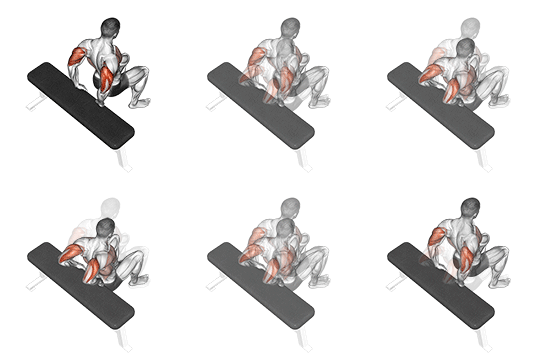
1. Bench dip
Hands on the edge of a chair or bench behind you, feet on the floor. This is the real entry point for most people, and it teaches you to lock the elbow out under light load.
Its limitation is known: it puts the shoulder in internal rotation, so it is a stepping stone, not a destination. Once you can do 3 × 15 with straight legs, move up.
2. Straight bar dip or negatives
Jump to the top and lower as slowly as you can to 90°. You can control roughly 30-40% more load eccentrically than concentrically, so negatives let you train the full movement before you can perform it.
Three or four negatives per set, twice a week. More does not speed anything up and does load the elbow.
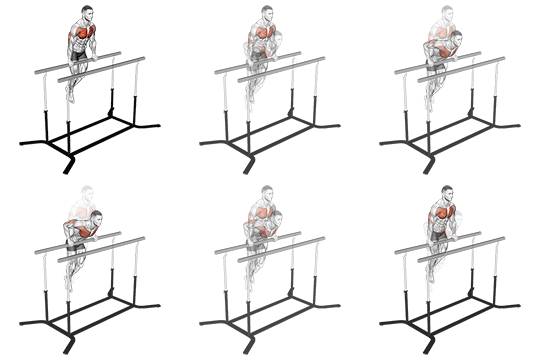
3. Full parallel bar dip
Body vertical, shoulders pulled down away from the ears, elbows pointing back rather than out, eyes forward. Lower under control to 90°, press up to lockout without bouncing.
Consider it consolidated at 3 sets of 8 clean reps with a half-second pause at the bottom. Until then, do not add difficulty.
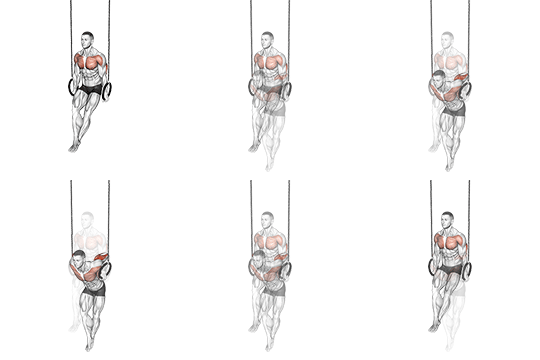
4. Ring dip
The largest jump in difficulty on the whole ladder, because rings move and force you to stabilise. Start with the rings low and your feet on the floor to scale the load, palms facing inward.
The intermediate goal is the ring dip with hands turned out at lockout. That turn-out is the gateway to most advanced ring work.
The four mistakes behind almost all the pain
- Going deeper than you control. The most common and the most expensive. Range you cannot hold with depressed shoulders is range you do not own yet.
- Elbows flaring out. Turns a pressing exercise into a lever on the shoulder capsule. Elbows travel backwards.
- Shrugging at the bottom. If your neck disappears at the bottom, the scapula has stopped working and the joint is absorbing the load.
- Bouncing out of the bottom. The connective tissue in the elbow takes the entire spike. If you need the bounce, the rung is too high.
Fitting it into your week
The dip is heavy pushing work: it goes at the start of the session while you are fresh, not at the end as a finisher.
| Level | Frequency | Volume per session |
|---|---|---|
| Cannot do any | 3 × week | 4 × 8-12 bench dips, or 4 × 3 negatives |
| Can do 1-5 | 2-3 × week | 5 × 3-5, stopping well short of failure |
| Can do 8+ | 2 × week | 4 × 6-10, or move to rings / added weight |
Always leave one or two reps in reserve. The dip is one of those exercises where hitting failure with broken form costs disproportionately, because form breaks down precisely in the riskiest position.
If your shoulder hurts during dips
Stop. This is not an exercise you can train through, because what hurts is usually tendon or capsule, and neither adapts to more volume.
- Halve your range and check whether the pain disappears completely. If it does, that is your range for three weeks.
- Add scapular work: active hangs and face pulls, twice a week.
- Audit your push/pull balance. A ratio skewed heavily towards pushing is the underlying cause in a great many sore shoulders: for every pushing set, do at least one pulling set.
If the pain persists after two weeks of avoiding end range, that is a physiotherapist, not an article.
Where this sits in a plan
The dip is one rung in the pushing chain, not a standalone exercise. Push-up variations come before it; weighted dips and ring work come after.
The app places the rung that matches your pushing score from the strength test, and changes it when that score rises — which is exactly the decision a fixed PDF cannot make for you. The exercise library has the full ladder ordered by real difficulty, 5 to 100.