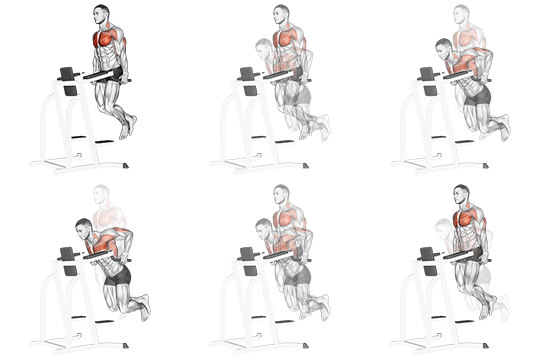
The question is usually framed badly. "Which is better?" has no answer because they do not share a goal. What can be answered is what each one produces, and for which person.
Hypertrophy: essentially a tie
The hypertrophy literature converges on the same thing: the determining factor is the number of effective sets taken close to failure, not the tool. A muscle does not distinguish between the tension a dumbbell produces and the tension your own weight produces — it responds to mechanical tension, volume and progression.
Where the gym wins is ease of dosing. Adding 2.5 kg to a press is trivial; finding the push-up variant that represents 5% more load than the last one is not. That does not mean calisthenics progresses less, it means progressing takes more judgement.
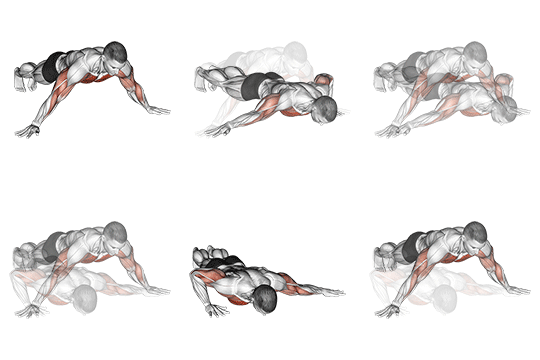
Where calisthenics wins is stabiliser work. A ring dip forces you to control shoulder rotation in a way a machine press does not. That does not show up on the scale, but it does show up in how the shoulder behaves five years later.
Legs: the gym wins, and it is only honest to say so
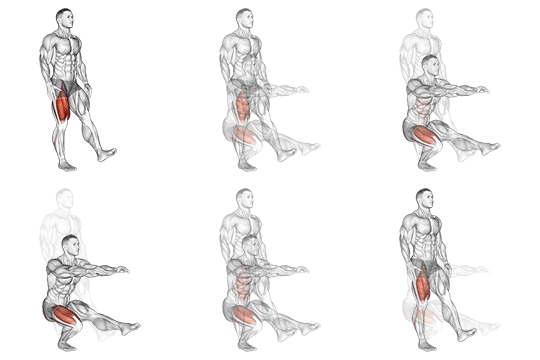
This is calisthenics' real weak point. The lower body can move far more load than bodyweight can offer, and the alternatives — single-leg squats, nordic curls, jumps — hit a ceiling relatively early.
You can have strong, functional legs with bodyweight alone. What is very difficult is maximising their development. If the lower body is your priority, a loaded barbell is the right tool and there is nothing more to argue about.
Relative strength and body control: calisthenics wins clearly
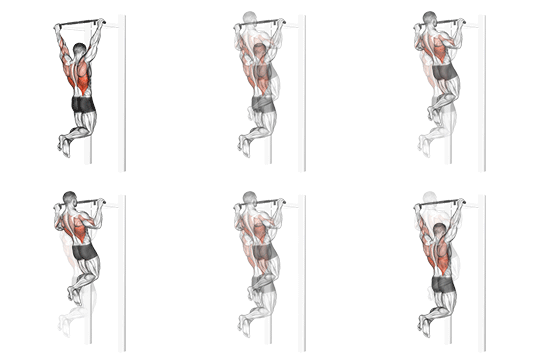
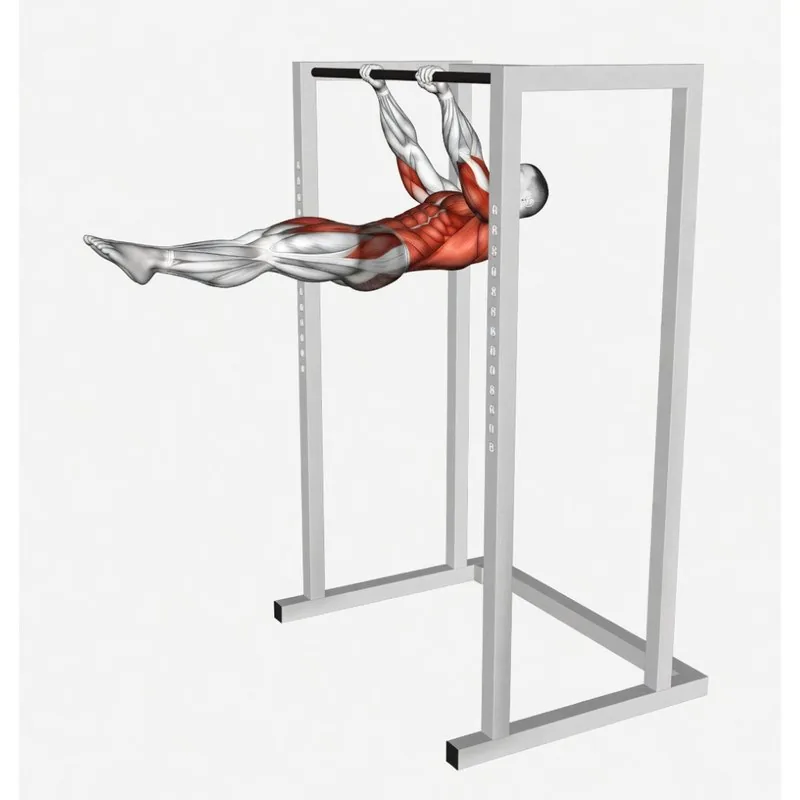
A front lever, a free handstand or a one-arm pull-up are expressions of relative strength — how much you can move in proportion to what you weigh. That axis is not trained with machines, and people coming from years of weights usually discover their core score is half what they expected.
It is also where the addictive part lives. A 100 kg bench press is a number; a muscle up is something you can either do or not do, and that binary turns out to be a far more powerful motivator for a lot of people.
The honest table
| Criterion | Calisthenics | Gym |
|---|---|---|
| Upper body hypertrophy | High | High |
| Lower body hypertrophy | Medium | High |
| Absolute maximal strength | Medium | High |
| Relative strength | High | Medium |
| Control and stability | High | Medium |
| Ease of progressing | Medium | High |
| Cost | €0 | €30-60/month |
| Depends on a venue | No | Yes |
| Entry curve | Gentle | Medium |
The variable that actually decides
None of the rows above matters as much as adherence. The best programme is the one you are still doing in month fourteen, and there calisthenics has a structural advantage: it does not depend on a timetable, a commute or a subscription.
The weeks lost to travel, moving house or chaotic months are the gym's silent tax. Being able to train in a hotel room with a chair does not make the session better — it makes the session exist.
What gets said that is not true
- "Calisthenics does not build muscle." False. A weighted dip and a bench press produce the same kind of stimulus. What does not build muscle is training without progression, in either place.
- "Weights make you stiff." False. Range of motion depends on how you train, not on the tool. A deep squat produces more hip mobility than a lot of stretching.
- "You do not get injured doing calisthenics." False. Wrists, elbows and shoulders pay for rushing skills, and elbow tendinopathies from skipping progressions are very common.
- "Calisthenics takes longer." Depends on what for. For your first pull-up there is no shortcut anywhere. For a 100 kg press, the barbell is more direct.
If you are coming from the gym
Expect an unpleasant surprise in two places: core work and horizontal pulling. Arriving with 70 on push and 35 on core is common. It is not a personal failing: it is what happens when the core is trained as an end-of-session accessory for years.
The fast way to find out where you stand is to measure it. The level calculator uses the same maths as the app's test and gives you a score per chain in five minutes.