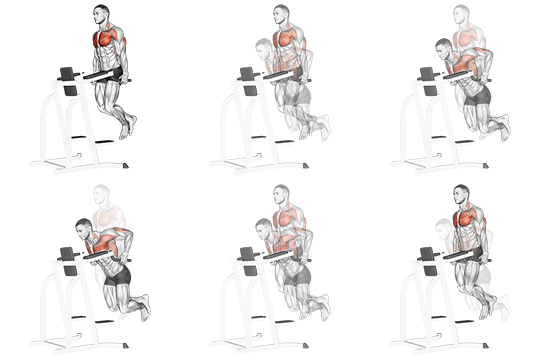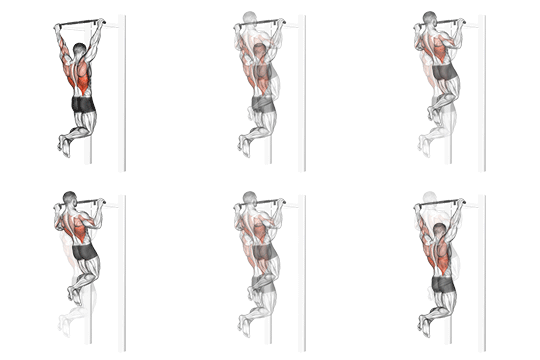
The most repeated objection to calisthenics is that you cannot progress because bodyweight is fixed. It is false, but it points at a real problem: in bodyweight training, progression is not automatic. Nobody adds a plate for you. You have to choose which variable to move, and there are six.
1. Change the variant
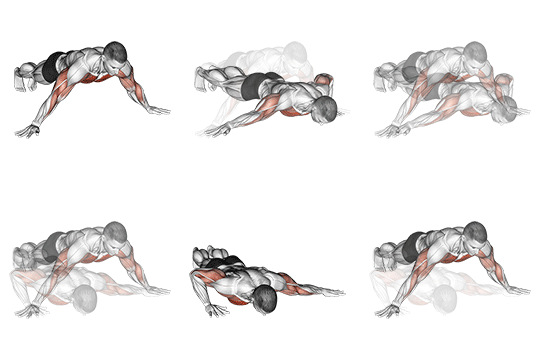
The main lever. Going from incline push-up to standard to decline to archer to one-arm is a ladder of resistance covering everything from day one to very advanced levels.
It is also the one most often misused. People skip two rungs at once, cannot perform the new one with form, and go back to the previous one feeling stuck. The practical rule: you change variant when you can do three sets of the current one with two reps in reserve.
2. Lengthen the lever arm
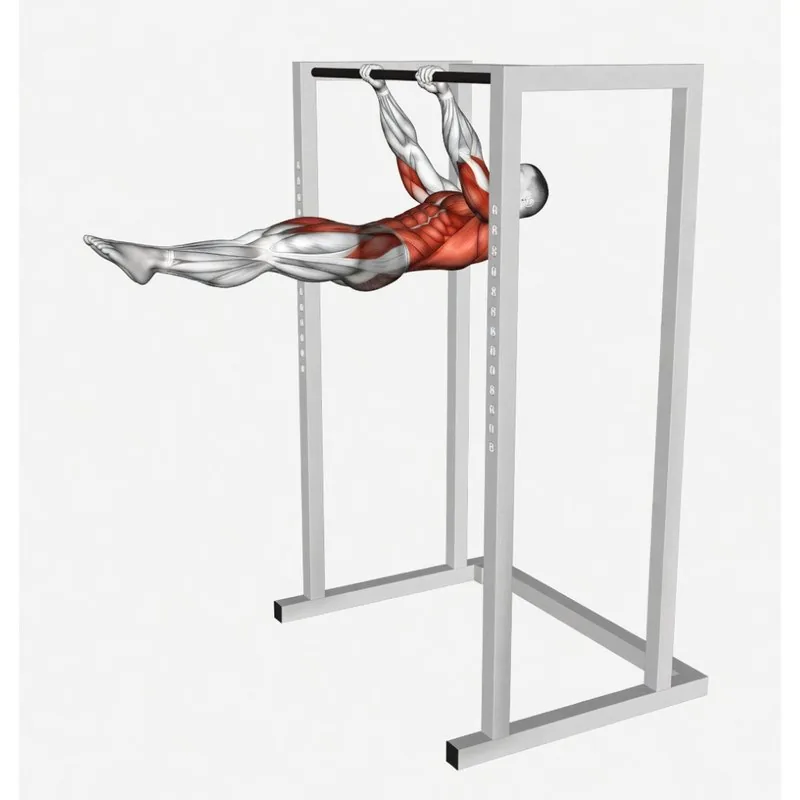
Lever physics is why a tuck front lever is accessible and a full one is elite. The further your centre of mass sits from the pivot, the more torque the muscle has to produce.
It applies everywhere: elevating your feet in a push-up, extending your legs in an L-sit, opening the hips in a lever. It is a continuous progression rather than a stepped one — you can move the angle a degree a week.
| Position | Relative difficulty | Example |
|---|---|---|
| Tuck | ~1× | Knees to chest |
| Advanced tuck | ~1.5× | Flat back, bent knees |
| Straddle | ~2.5× | Legs open in a V |
| Full | ~4× | Body fully extended |
3. Increase time under tension
Ten push-ups in twenty seconds and ten push-ups in sixty seconds are different stimuli. Slowing the eccentric to three or four seconds, or pausing for two seconds at the bottom, raises the demand without changing exercise or touching form.
It is the most useful lever when you are between two variants: the current one is easy, the next one will not come out yet. Slow the current one down for three or four weeks and the next one appears.
4. Reduce the base of support
Going from two hands to one and a half (archer), from two legs to one, from wide hands to narrow. It doubles the relative load with no equipment and exposes asymmetries that bilateral movements hide.
A warning: unilateral work reaches the limit of connective tissue before the limit of muscle. Introduce it with low volume and raise it slowly.
5. Add range of motion
Push-ups on parallettes or books let the chest drop below the hands. Deeper dips. Pull-ups to the sternum rather than to the chin. More range is more work per rep and, generally, more hypertrophy per set.
It is the free lever: it costs nothing, needs no equipment, and almost everyone is leaving range on the table.
6. Add external weight
A backpack full of books, a weighted vest or a dip belt. This is the last lever, not the first: it makes sense once you already own the hardest variant of a pattern at full range, not as a shortcut around the variant ladder.
The exception is the basics. Weighted pull-ups and dips are among the most efficient ways to build raw strength in calisthenics, and they are worth introducing as soon as you have twelve clean unweighted reps.
The order worth using them in
They are not interchangeable. This is the order that causes the fewest problems:
- Full range in the current variant
- More reps up to the top of the target range
- More time under tension (slow eccentrics, pauses)
- Next variant on the ladder
- Longer lever or smaller base
- External weight
How this translates into a routine
The reason a fixed plan stops working is that it does not know where on these six levers you are. It is easy to write "3 × 10 push-ups" in a PDF; it is impossible for that PDF to know you already do fifteen and it is time to move to declines.
The app solves that by measuring: the strength test places your level between 0 and 100 per chain, and the routine is built with the variant that number corresponds to. When the number goes up, the variant changes. You can do the same by hand — it just takes being honest about the exit criterion and not skipping rungs.
If you want to see the full ladder for a specific pattern, the exercise library is ordered by real difficulty from 5 to 100.