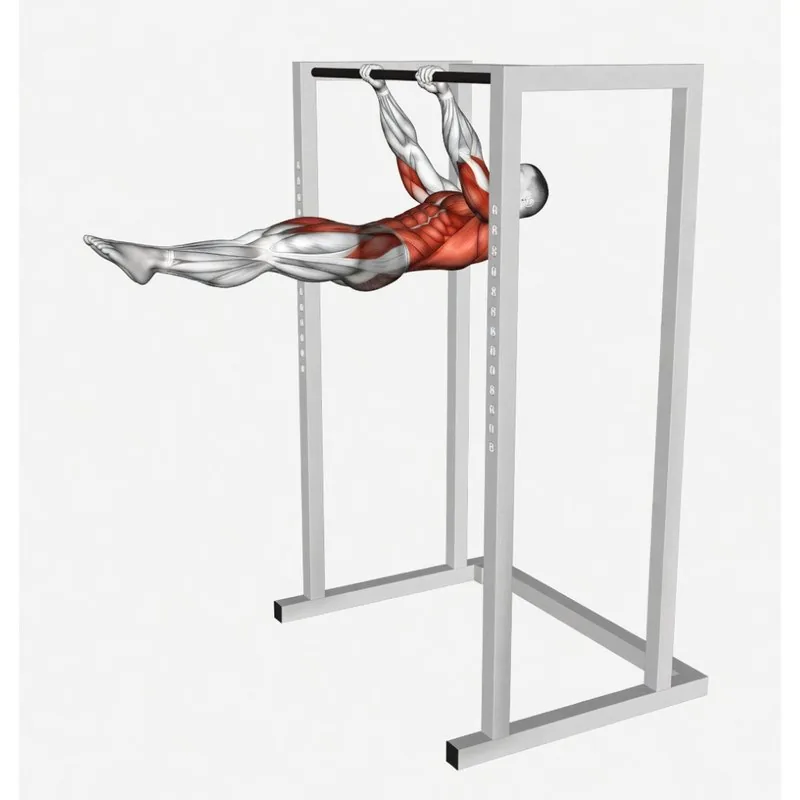
The first pull-up is the entry filter of calisthenics. It is also where most people quit, almost always for the same reason: they train the finished movement instead of training whatever is missing.
A pull-up demands three things at once — pulling strength, scapular control, and a core that stops the body turning into a pendulum. If the first is missing, hanging from the bar and kicking does not build it. If the second is missing, you can have strength to spare and still never leave the bottom. This plan separates all three.
Before you start: the diagnostic
Do these three tests on the same day, fully rested between them. The result decides which week you enter at — not how long you have been training.
| Test | What it measures | Minimum to pass |
|---|---|---|
| Active hang | Grip and scapular control | 30 seconds |
| Australian pull-up (body at 45°) | Horizontal pulling strength | 10 clean reps |
| Pull-up negative | Vertical pulling strength | 15 seconds of controlled descent |
The four exercises that actually matter
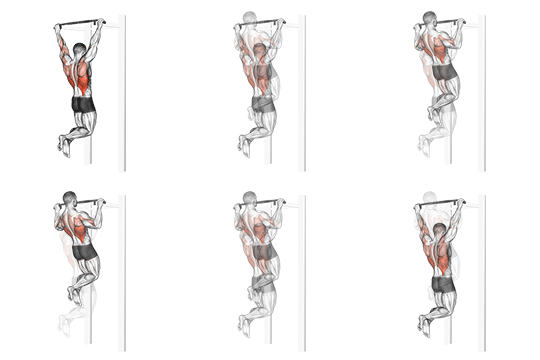
1. Active hang
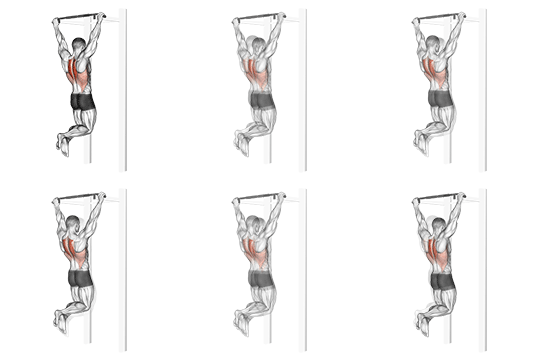
Hang from the bar and, without bending your elbows, pull your shoulders down and away from your ears. Your body rises two or three centimetres. That is scapular depression, and it is the first centimetre of every pull-up you will ever do.
Most people who "cannot do pull-ups" have never consciously found this position. Without it, the pull starts from a hanging joint rather than a loaded muscle.
2. Australian pull-up
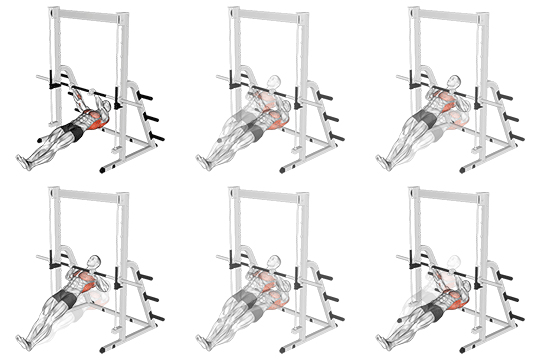
Lying under a low bar, body straight, pull your chest to the bar. It is the best pulling-strength builder for beginners because you can dial the difficulty to the centimetre by changing your body angle: the more horizontal, the harder.
This is where most of your volume belongs for the first six weeks. It is not a warm-up exercise.
3. Negatives
Jump or step up to the top of the bar and lower as slowly as you can. You can control 30–40% more load in the eccentric than in the concentric, so a negative lets you train the full movement before you can perform it.
The classic mistake is doing too many. They are very demanding on connective tissue: three or four per session, twice a week, is plenty. More produces sore elbows, not pull-ups.
4. Scapular work on the bar
Dynamic active hangs: raise and lower your shoulders without bending your elbows, 8–10 reps. It is boring, and it is what unlocks people who already have the strength but cannot get the movement started.
The 12-week plan
Three sessions a week with at least one rest day between them. Each block has a numeric exit criterion: you advance on a mark, not on the calendar.
Weeks 1-4 — build the base
- Active hang: 4 × max (target: reach 45 s)
- Australian pull-up: 4 × 8-12, body progressively more horizontal
- Scapular retraction on the bar: 3 × 8
- Band face pulls or wide-grip inverted rows: 3 × 12
Exit criterion: 12 australians with the body horizontal, and a 45-second active hang.
Weeks 5-8 — introduce the vertical
- Pull-up negatives: 4 × 1, 8-10 s descent
- Feet-elevated australian pull-up: 4 × 8-10
- Band-assisted pull-ups: 3 × 5
- Active hang: 3 × max
Exit criterion: one 20-second negative controlled from start to finish, with no free-fall in the last third.
Weeks 9-12 — go for the rep
- Full pull-up attempt: 5 × 1 (even if it fails), 3 min rest
- Negatives: 3 × 1 at 10 s, after the attempts
- Feet-elevated australians: 3 × 10
- Grip work: alternating one-arm hangs, 3 × 10 s per side
The attempts come first, while you are fresh. Attempting your pull-up at the end of a session is exactly why a lot of people spend months "almost there".
The five mistakes that cost the most time
- Only using band-assisted pull-ups. The band helps most at the bottom, which is where the problem is, and almost nothing at the top. Alternate with negatives, which load precisely the range the band gives away.
- Training to failure every day. Vertical pulling fatigues elbows and shoulders more than it feels like. Three quality sessions a week beat six spent dragging yourself around.
- Ignoring bodyweight. A pull-up is a ratio between strength and mass. Losing three kilos of fat has the same effect as weeks of training, and the two add up.
- Kipping from day one. The swing gives you the rep without giving you the strength. As an occasional rung it is fine; as a habit it freezes progress for months.
- Not training grip separately. If you let go of the bar before your back gives out, your back is not your limit.
How long it really takes
Three sessions a week from absolute zero puts the honest range at eight to twenty weeks. The variable that matters most is neither genetics nor programme: it is how many weeks in a row you train without stopping. Two consistent months beat six intermittent ones, and not by a little.
If you want a rough number from where you are today, the progression calculator makes the estimate. And if you would rather the plan adjusted itself as you improve, that is exactly what the app does.
After the first one
The first pull-up is a strange threshold: going from one to five takes far less time than going from zero to one. As soon as you have one, change the target to three sets of five with clean form — and from there everything opens up: muscle up, front lever and weighted work.