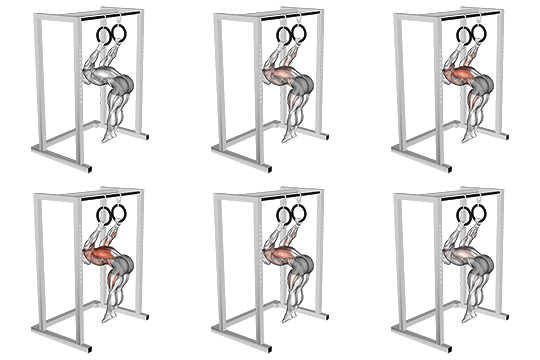
There is a point in calisthenics where a lot of people stall and read it as a strength problem when it is a range problem. The handstand that always falls over, the muscle up that never quite passes, the dip that pinches: in all three the shoulder is usually the culprit, not the muscle.
And the fix is not more stretching. Passive stretching buys range you cannot use under load. What you need is range with control, which is trained differently.
Mobility is not flexibility
The distinction sounds like a technicality and it is the key to the whole thing:
| Flexibility | Mobility | |
|---|---|---|
| What it is | Passive range you can reach | Range you control actively |
| How it is measured | Someone pushes you to the limit | You get there alone, unaided |
| How it is trained | Sustained stretching | Strength at end range |
| What it is good for | Little, on its own | Everything you do under load |
If lying down you can bring your arms overhead to touch the floor, but standing you cannot raise them past vertical without arching your back, you do not have a flexibility problem. You have range your body does not know how to use.
Three tests that tell you where you stand
1. Wall shoulder flexion
Back to the wall, heels, glutes and lower back touching. Raise straight arms in front of you until they touch the wall overhead, without your lower back peeling away.
- Touch without peeling: enough range for overhead work.
- Touch but the back arches: you are stealing range from your spine. This is the pattern that breaks handstands.
- Cannot touch: insufficient range; handstands and HSPU will be a struggle until you address it.
2. Shoulder extension
Seated, hands on the floor behind you with fingers pointing back, slide your body forward keeping your arms straight. Measure how far you can go before the shoulder complains.
This is the range you need for the deep dip and for the muscle up transition. It is also the one most commonly missing in people who work at a desk.
3. External rotation at 90°
Elbow tucked at your side, bent to 90°, rotate your forearm outward. You should approach 90 degrees without the elbow moving.
Limited external rotation is the most frequently cited risk factor in pushing-related shoulder pain. If you come up short here, strengthening that rotation takes priority over everything else.
The work that actually changes things
Four exercises. You do not need more, and these have support behind them as active-range work:
Shoulder dislocates with a stick or band
Hold a band or broomstick with a very wide grip and pass straight arms from front to back overhead. Start so wide it is easy and narrow the grip week by week.
This is the entry point for almost everyone. Two sets of ten, daily if you like, before training.
Active and passive hangs
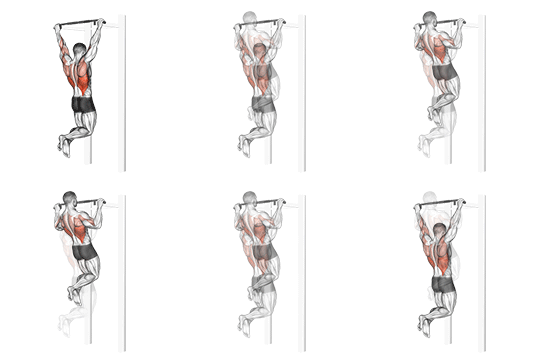
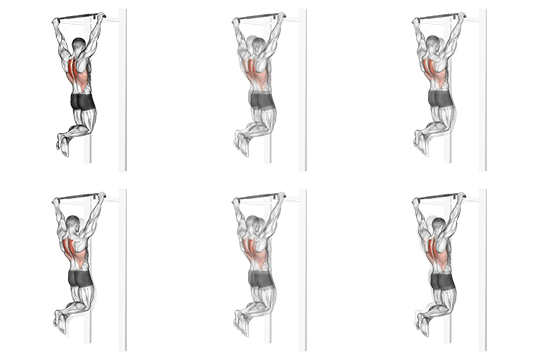
Hanging from a bar is the best shoulder-health tool there is, and almost nobody uses it for its own sake. Start with active hangs (shoulders depressed) and, as tolerance builds, add time in a relaxed hang.
A reasonable target: one continuous minute, accumulated across the day if needed.
Skin the cat, progressed slowly
The best builder of loaded shoulder range in calisthenics, and also the one that deserves the most respect. Progress it very gradually: start with the rings low, feet touching the floor, and lower centimetre by centimetre over weeks.
Never do it cold, never force the end of the range, and if anything pinches, come back up. The connective tissue of the shoulder takes months to adapt to this position.
Face pulls
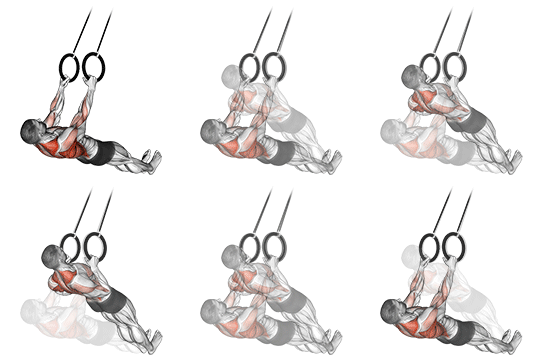
With a band or rings, pull towards your face, separating your hands at the end and rotating outward. Strengthens the external rotators and upper back, which is precisely what offsets excess pushing.
Three sets of fifteen, two or three times a week. The best time-to-benefit preventive work there is for a shoulder doing calisthenics.
When to do it
| Moment | What belongs there | Why |
|---|---|---|
| Before training | Dislocates, circles, active range | Prepares without costing strength |
| During the session | Face pulls, hangs | This is strength work, not filler |
| After, or on rest days | Skin the cat, end range | Needs you warm and unhurried |
The push/pull balance
No mobility routine compensates for a structural imbalance. If you do three times as much pushing volume as pulling — the default for almost anyone training at home without a bar — the shoulder will eventually complain, however many dislocates you do.
The reference ratio is at least one pulling set per pushing set, and if you already have niggles or work at a desk, two to one for a few months. That is the adjustment that resolves the most shoulder pain, and it is not a mobility exercise: it is programming.
If it already hurts
None of the above is treatment. Mobility prevents; it does not cure an irritated tendon. If there is pain:
- Remove the movement that provokes it, not the whole session.
- Keep loading in ranges that do not hurt — tendon adapts to tolerable load, not to complete rest.
- If it has not improved in two or three weeks, see a physiotherapist. An article cannot examine your shoulder.
Where it fits
If the handstand, muscle up or HSPU are resisting you and you suspect range rather than strength, the full progressions are in skills, and each pattern ladder is in the exercise library. If the shoulder specifically bothers you during dips, the detail is in parallel bar dips.