Most "no equipment" routines are lists of exercises with no progression criterion. They work for four weeks and then you are stuck doing the same thing indefinitely, which is exactly the problem you came to solve.
This one has three days, covers all four patterns — push, pull, legs and core — and includes what to do when each exercise stops costing you anything.
The pulling problem
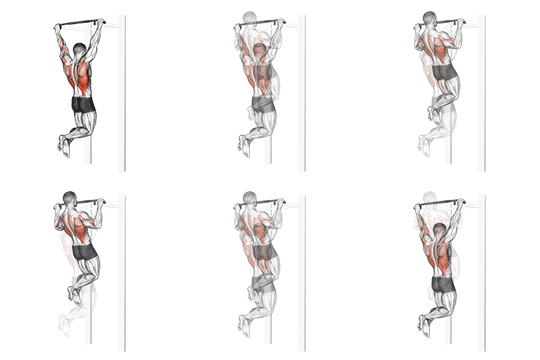
This has to be said before we start: with nothing to hang from, pulling is hard to train well. It can be mitigated, not solved.
The best options without a bar are rows under a sturdy table (gripping the edge with your body underneath), isometric pulls against a towel run through a door frame, and reverse snow angels on the floor. None of them replaces a pull-up.
Day A — Push and core
| Exercise | Sets × reps | Rest |
|---|---|---|
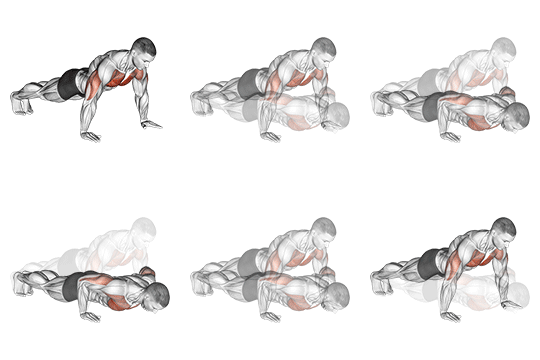
| Push-up (the variant that leaves you 2 in reserve) | 4 × 8-12 | 90 s |
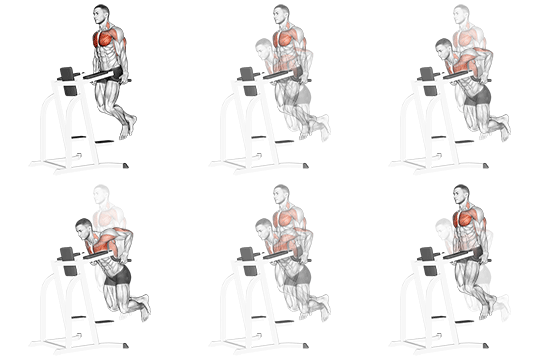
| Chair dip | 3 × 10-15 | 75 s |
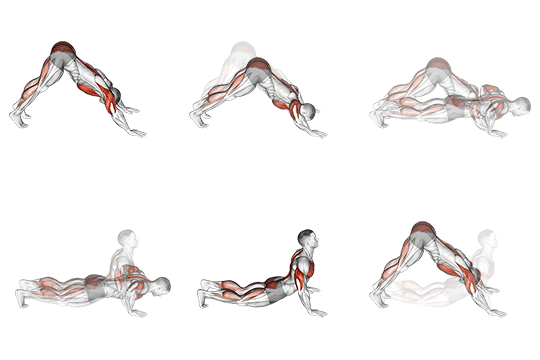
| Pike push-up (feet on the chair) | 3 × 6-10 | 90 s |
| Front plank | 3 × 30-60 s | 60 s |
| Lying leg raise | 3 × 12-15 | 60 s |
Day B — Legs and core
| Exercise | Sets × reps | Rest |
|---|---|---|
| Bulgarian split squat (rear foot on the chair) | 4 × 8-12 per leg | 90 s |
| Deep squat | 3 × 15-20 | 75 s |
| Single-leg glute bridge | 3 × 12 per side | 60 s |
| Single-leg calf raise | 3 × 15-20 | 45 s |
| Hollow hold | 3 × 20-40 s | 60 s |
Day C — Pull and full body
| Exercise | Sets × reps | Rest |
|---|---|---|
| Table row (or bar row if you have one) | 4 × 8-12 | 90 s |
| Reverse snow angel on the floor | 3 × 12-15 | 45 s |
| Archer or diamond push-up | 3 × 6-10 | 90 s |
| Bulgarian split squat | 3 × 10 per leg | 75 s |
| Side plank | 3 × 30 s per side | 45 s |
How to progress when it stops being hard
This is the part missing from almost every home routine. When you hit the top of the rep range across all four sets, you move to the next box.
| Pattern | Progression ladder |
|---|---|
| Horizontal push | Wall → high incline → knees → standard → decline → diamond → archer → one arm |
| Vertical push | Pike → feet-elevated pike → wall handstand → partial HSPU → full HSPU |
| Squat | Squat → bulgarian → shrimp → assisted pistol → free pistol |
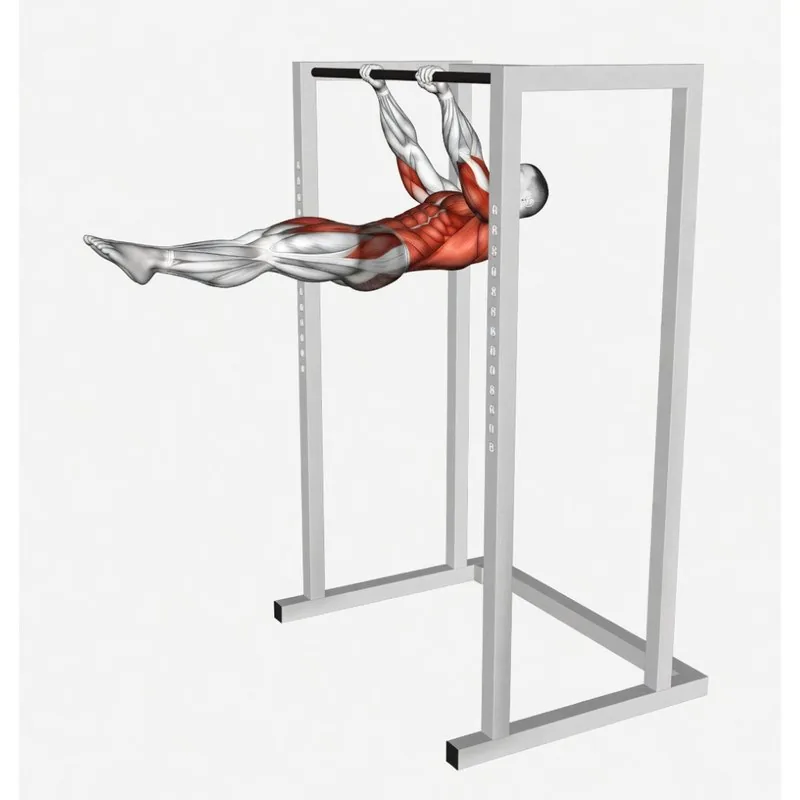
| Core | Plank → hollow hold → lying raises → tuck dragon flag → dragon flag |
Every box on those ladders exists in the exercise library with its animation and detailed execution.
Frequency and rest
Three sessions a week, non-consecutive — Monday, Wednesday, Friday for example. If you have four days available, repeat day A: pushing tolerates more frequency than legs do.
Every six to eight weeks, halve the volume for a week. It is not optional once you have been going for months: fatigue accumulates below the radar, and the first sign is usually performance dropping two sessions in a row for no apparent reason.
The mistakes home routines make
- Always doing the same reps. If you have been doing 3 × 15 push-ups for three months, you are not training, you are maintaining.
- Ignoring pulling because it is awkward to set up. A large push/pull imbalance ends in shoulder pain, and it is the pattern that shows up most often in people who train only at home.
- Always going to failure. With little equipment it is tempting to compensate for missing load with more agonising reps. That produces fatigue, not adaptation.
- Not timing rest. A phone in your hand turns 90 seconds into four minutes and the session into an hour and a half.
If you want it to adjust itself
This plan is generic on purpose: it suits the middle of the distribution. If you want one built on your real level per chain and the exact equipment you own, that is the app's main job — you tick floor, wall and chair, take the test, and out comes a routine with the variants that correspond to you.